

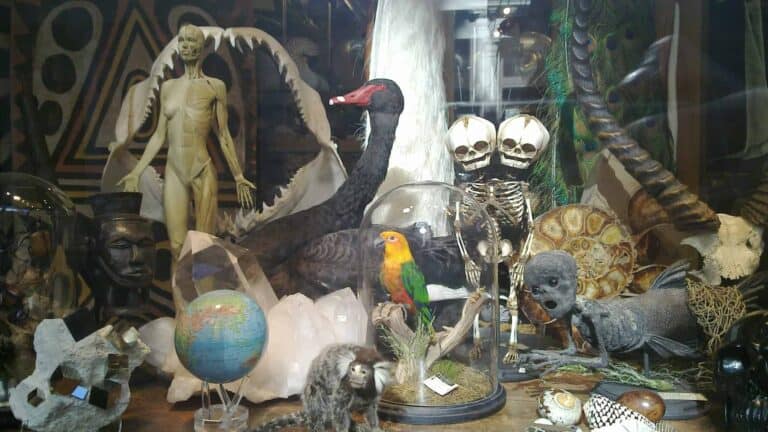

The cabinet of curiosities is one of the most fascinating concepts in the history of human knowledge. Emerging in the 16th century, these extraordinary private collections assembled objects from across the known world — exquisite artefacts, works of art, natural anomalies and scientific instruments — into a single room or cabinet intended to inspire wonder and learning. Known in German as the Wunderkammer (wonder room) or Kunstkammer (art room), they walked a deliberate line between the encyclopaedic and the theatrical. In doing so, they laid the foundations for the modern museum.
The British Museum itself grew from this tradition — its founding collection was, in essence, a cabinet of curiosities assembled by Sir Hans Sloane. That lineage connects the Renaissance impulse to collect and classify with the great public institutions we visit today. Moreover, for those of us drawn to flea markets, antique fairs and curio shops, the spirit of the Wunderkammer is very much alive in every unexpected find.
Origins of the Cabinet of Curiosities
Cabinets of curiosities emerged during the Renaissance, when a renewed fascination with the natural world and the artefacts of distant lands drove scholars, aristocrats and monarchs to collect. These collections were initially private — part personal encyclopaedia, part status symbol, demonstrating the wealth, education and taste of the owner. To possess a Wunderkammer was to demonstrate that you had access to the world’s wonders: rare minerals from distant mines, anatomical specimens, Roman coins, mechanical automata and painted depictions of the exotic and the strange.
The cabinets typically divided their contents into three categories. Naturalia covered objects from the natural world — shells, fossils, taxidermy, botanical specimens. Artificialia encompassed man-made objects, from sculptures and paintings to scientific instruments. Mirabilia were the wonders: items that defied easy classification, that amazed and puzzled in equal measure. Together, these three categories formed a miniature model of the universe as the Renaissance mind understood it.
Iconic Wunderkammern Through History
One of the most celebrated early cabinets was that of Ferdinand II, Archduke of Austria, whose Kunst- und Wunderkammer at Ambras Castle became renowned across Europe. The collection was notable for its paintings of people with physical deformities, rare weapons, armour and scientific instruments — reflecting the era’s fascination with the boundaries of the natural and the supernatural.
In Dresden, the Green Vault (Grünes Gewölbe) represents the Wunderkammer tradition at its most magnificent. Housed in a meticulously restored Baroque palace, it displays an astonishing array of treasures — precious gems, gold and silver work, ivory carvings and exquisite miniatures. It remains one of the greatest treasure rooms in the world and a direct descendant of the original Wunderkammer impulse.
The tradition of the Kunstschranke — miniature Kunstkammer cabinets conceived by merchant diplomat Philipp Hainhofer — brought the concept to a more personal scale. These compact cabinets were filled with a diverse range of objects intended for both education and private enjoyment. They are the direct ancestors of today’s curio cabinets and display cases.
From Private Collection to Public Museum
The transition from private Wunderkammer to public museum happened gradually across the 17th and 18th centuries. As Enlightenment thinking prioritised rational classification over wonder, collections became more systematic. Natural history museums separated specimens by species; art museums arranged objects by school and period. The glorious chaos of the original cabinet of curiosities gave way to the ordered gallery.
Nevertheless, the British Museum’s Enlightenment Gallery — opened in 2003 in the King’s Library — consciously pays homage to those roots. It recreates the eclectic spirit of an 18th-century museum room, mixing natural specimens, classical sculptures, coins, books and scientific instruments in a single space that encourages exactly the kind of open-ended wonder the Wunderkammer was designed to provoke.
The Wunderkammer Tradition Today
The spirit of the cabinet of curiosities lives on in some unexpected places. The Evolution Store in New York City is essentially a retail Wunderkammer — offering taxidermy animals, fossils, anatomical models and natural scientific curiosities to the public. Similarly, the House on the Rock in Wisconsin blends real and fabricated objects in a deliberately disorienting way, creating a modern take on the tradition of mixing the authentic with the marvellous.
In Los Angeles, the Museum of Jurassic Technology takes a more conceptual approach — deliberately blurring the line between fact and fiction in a way that would have delighted a Renaissance collector. It challenges visitors to question what they think they know, which is precisely the function the original Wunderkammer was designed to serve.
For flea market enthusiasts, the connection is direct. Every flea market stall is a miniature Wunderkammer — an accumulation of objects from different eras, cultures and contexts, waiting to be discovered, interpreted and appreciated. The thrill of finding an unusual curiosity in an antique fair, the pleasure of holding an object with an unknown history, the desire to understand what something is and where it came from — all of these are the same impulses that drove the Renaissance collectors who assembled the first cabinets of curiosities.
Why the Cabinet of Curiosities Still Matters
The enduring appeal of the Wunderkammer lies in what it represents: the human desire to look closely, to collect, to understand. In an era of digital information, there is something deeply compelling about the tangible and the physical. A fossil, a mechanical clock, an antique map or a piece of handmade jewellery carries a kind of meaning that a photograph or a database entry cannot fully replicate.
Furthermore, the cabinet of curiosities reminds us that knowledge need not be linear or systematic to be valuable. The Wunderkammer placed a Roman coin next to a stuffed crocodile next to a mechanical orrery — and in doing so, it invited the viewer to find connections, to ask questions, to wonder. That kind of open-ended, associative thinking is as valuable today as it was in the 16th century. As a result, the tradition of the Wunderkammer endures not just in museums, but in every curio shop, antique fair and flea market where curious people go looking for something they didn’t know they needed.
Frequently Asked Questions
What is a cabinet of curiosities?
A cabinet of curiosities (also called a Wunderkammer or Kunstkammer) is a collection of extraordinary or unusual objects assembled to inspire wonder and learning. Originating in 16th-century Europe, these collections typically contained natural specimens (shells, fossils, taxidermy), man-made artefacts (sculptures, scientific instruments, coins) and items that defied easy classification. They were the precursors to the modern museum.
What is the difference between a Wunderkammer and a Kunstkammer?
The terms are related but distinct. Wunderkammer translates as “wonder room” and emphasises the astonishing, the marvellous and the strange. Kunstkammer translates as “art room” and places greater emphasis on man-made objects of artistic or technical merit. In practice, many historical collections blended both impulses, and the terms are often used interchangeably.
Where can I see a cabinet of curiosities today?
Several institutions preserve or recreate the spirit of the original cabinets. The British Museum’s Enlightenment Gallery in London recreates an 18th-century collection room. Dresden’s Green Vault (Grünes Gewölbe) is one of the most spectacular historic treasure rooms in the world. The Museum of Jurassic Technology in Los Angeles offers a contemporary, conceptual take on the tradition. The Evolution Store in New York City functions as a retail Wunderkammer.